Why AI Is Ruining the Job Market for Job Seekers
AI has made job searching faster, but also noisier, less trustworthy, and more luck-based. Learn what is changing and how to compete without becoming part of the spam problem.
Tailor your resume before you apply.
Upload your Master Resume, paste a job posting, and review a role-specific resume in minutes.
Start tailoring for free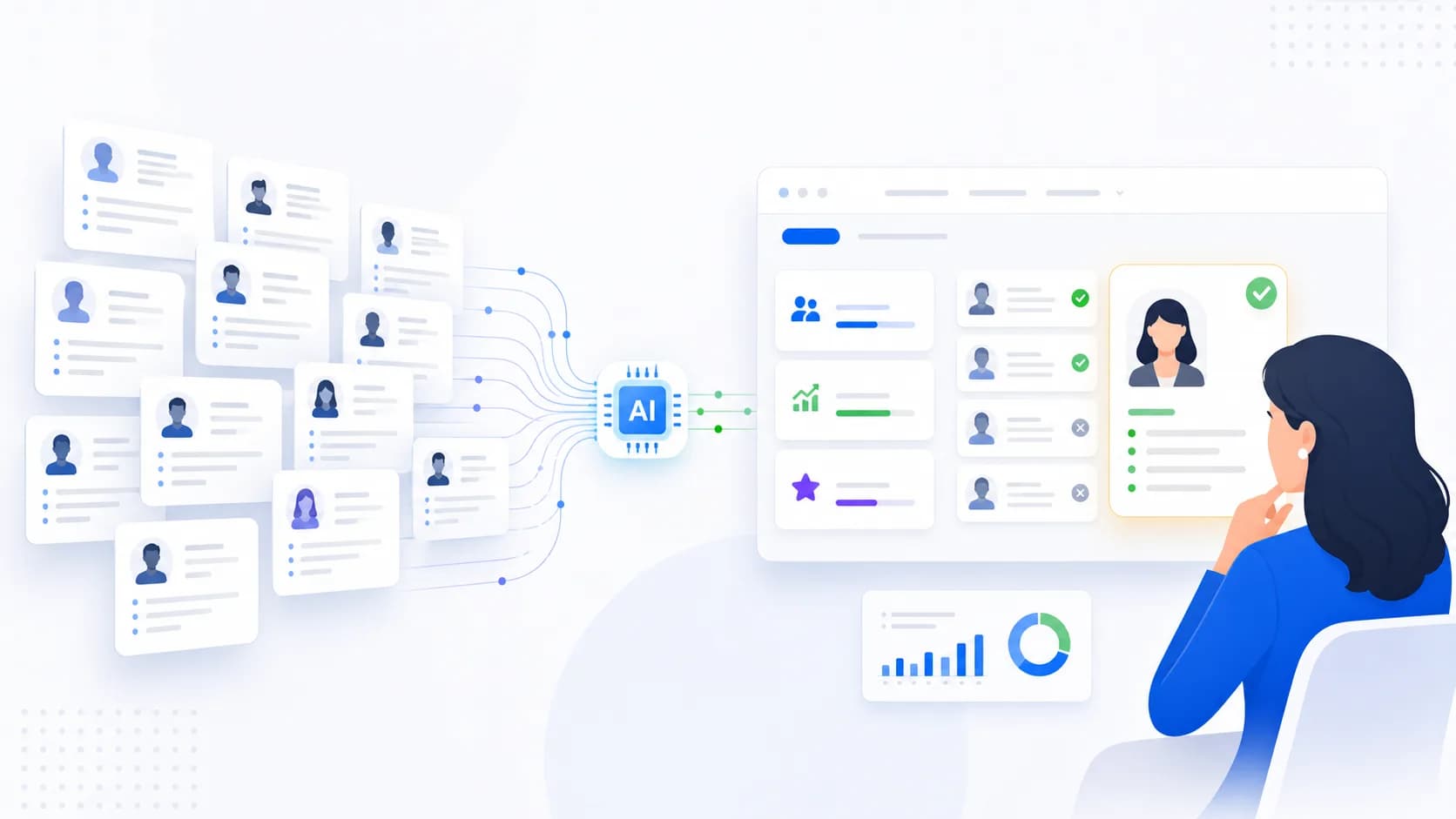
AI is not ruining the job market because every job suddenly disappeared.
It is ruining the job market because it has made the hiring process noisier, less trustworthy, and more random at the exact moment workers need clarity. Job seekers are using AI to generate resumes, cover letters, screening answers, and auto-applied submissions at industrial scale. Employers are using AI to screen, summarize, rank, and reject candidates faster. In between those two machines are real people trying to make career decisions with less feedback than ever.
The result is a strange job market where it can feel like you did everything right and still got nowhere. You applied to roles that matched your background. You tailored your resume. You answered the questions. Then silence. Meanwhile, hiring managers are staring at hundreds or thousands of polished applications that all sound the same.
The problem is not that AI exists. The problem is that too much of the job market now rewards volume, speed, and surface-level optimization over trust.
The labor market looks stable, but it feels much harder
The official U.S. data does not show a collapse. The May 2026 Bureau of Labor Statistics Employment Situation reported that nonfarm payroll employment increased by 172,000 and the unemployment rate stayed at 4.3 percent. That sounds healthy on the surface.
But job seekers do not experience the labor market as a single headline number. They experience it as the number of relevant roles they can find, the number of applications that get reviewed, the number of recruiters who respond, and the number of interviews that turn into offers.
Other labor-market signals show why the search feels tighter. The May 2026 BLS JOLTS release showed 7.6 million job openings, with hires at 5.2 million and layoffs and discharges at 1.7 million. Openings may still exist, but employers are being selective. Many teams are operating in a "wait and see" mode where they post jobs, collect applicants, and move slowly.
LinkedIn's 2026 labor market research also points to a colder hiring environment. Its global labor market report says hiring in advanced economies is still 20 to 35 percent below pre-pandemic levels, and that job seekers are outpacing job openings at the highest level since the pandemic.
That is the backdrop for the AI problem. AI did not create every weakness in the labor market. Interest rates, overhiring, layoffs, restructuring, and uncertainty all matter. But AI has changed the mechanics of applying, screening, and interviewing in ways that make a tough market feel broken.
AI auto-apply tools are flooding hiring teams with low-signal applications
Auto-apply tools promise an attractive bargain: give the software your resume, set your preferences, and let it apply to dozens or hundreds of jobs while you sleep.
For a frustrated job seeker, the appeal is obvious. If every application disappears into a black box, why not send more? If a tailored cover letter takes twenty minutes, why not let AI write it in twenty seconds? If job boards make applying as easy as clicking a button, why not click a lot?
The issue is that every applicant is making the same calculation. At scale, that creates an application denial-of-service attack on hiring teams.
LinkedIn data, summarized by HR Dive, found that U.S. applicants per open role have doubled since spring 2022. Recruiters are not simply receiving more qualified people. They are receiving more applications, more AI-polished resumes, and more candidates who may have barely read the posting.
Employers are noticing. A Robert Half survey reported that 65 percent of hiring managers say AI-generated resumes are creating hiring challenges, while 84 percent of HR leaders say their recruiting team's workload has increased.
This is the central contradiction of AI auto-apply. It may help one person submit more applications. But when many people use it, the entire system gets worse. Hiring managers become more skeptical. Recruiters add filters. Applicant tracking systems become stricter. Good candidates get buried under generic submissions that never should have been sent.
That hurts serious applicants most. If you are genuinely qualified and you submit a thoughtful resume, you are competing not only against other people, but also against the noise created by people who are applying to anything vaguely adjacent to their profile.
AI is making applications look better and mean less
Before generative AI, a weak application often looked weak. The resume was unfocused. The cover letter was generic. The answers were sparse. A recruiter could skim and move on.
Now weak applications can look polished.
AI can turn thin experience into confident prose. It can inflate responsibilities. It can mirror the exact language of the job description. It can produce a cover letter that sounds enthusiastic about any company in any industry. That does not mean the candidate is lying, but it does mean the written application is a weaker signal than it used to be.
This changes how hiring teams behave. If every resume says "cross-functional stakeholder management," "data-driven decision-making," and "AI-enabled workflow optimization," the words stop differentiating people. Recruiters look for harder proof: portfolio work, referrals, work samples, domain-specific examples, public projects, and interview performance.
It also changes the risk for job seekers. A resume is not just marketing copy. It is a set of claims you may need to defend in an interview. If an AI tool adds tools you barely used, overstates your ownership, or quietly changes "supported" into "led," it can create a mismatch that shows up later.
That mismatch damages trust. Even if the applicant did not intend to deceive anyone, the hiring team now has to wonder what else is AI gloss.
AI cheating is breaking technical interviews
Technical interviews were already imperfect. They often rewarded pattern recognition, test familiarity, and nerves under pressure. AI has made the weaknesses worse.
Real-time AI assistants can listen to interview questions, generate coding solutions, suggest explanations, and help candidates through assessments they could not complete unaided. Some tools market themselves specifically around hidden assistance during interviews. That changes the employer's problem from "Can this person solve the task?" to "Can we tell whether this person is solving the task?"
The scale is hard to measure across the whole market, but the signals are serious. Fabric analyzed 19,368 AI interviews and reported that 38.5 percent of candidates were flagged for cheating behavior, with technical roles showing higher rates than nontechnical ones. HackerRank has also published guidance on stopping AI cheating in remote technical assessments, noting that invisible AI assistants have made assessment integrity more complex.
This hurts honest candidates in two ways.
First, companies respond by making interviews more suspicious. They add proctoring, stricter rules, in-person rounds, deeper follow-up questions, and longer processes. Candidates who follow the rules now have to prove they are not cheating.
Second, cheating raises the apparent talent bar. If some applicants are using AI to perform beyond their real skill level, honest applicants may look slower or less polished in comparison. Hiring teams then recalibrate around a distorted view of what "good" looks like.
The long-term fix is better interview design: realistic work samples, paired problem solving, clearer AI-use policies, and questions that test judgment rather than memorized answers. But in the short term, job seekers are stuck inside a trust crisis.
Layoffs are putting more experienced candidates into the same pool
AI is also affecting the supply side of the job market. Even when AI is not the only reason for layoffs, companies are increasingly citing it as part of restructuring.
Challenger, Gray & Christmas reported that in May 2026, AI was cited for 38,579 announced job cuts and accounted for about 40 percent of cuts that month, according to its May 2026 job cut report. Year to date, the firm said AI had been cited in 87,714 cuts, surpassing the full-year 2025 total for that reason.
Those layoffs do not just remove jobs. They add more job seekers.
When experienced workers from technology, finance, media, operations, recruiting, support, and administrative roles enter the market at the same time, they compete for roles that may already have slower hiring cycles. Some apply one level down to stabilize their income. Some switch industries. Some move from management back into individual contributor roles. That creates pressure all the way down the ladder.
This is especially hard for early-career candidates. If a company can hire someone with five years of experience for a role that used to be open to someone with one or two years, the junior applicant has to fight harder to get noticed. AI then compounds the issue by making every candidate's documents look more senior, more strategic, and more keyword-aligned than they may actually be.
Again, AI is not the only force here. But it is part of a broader shift toward leaner teams, automation, and higher expectations for each hire.
The job search is becoming more luck-based
Job searching has always involved luck. But AI and high-volume platforms have made timing feel more important than ever.
If you apply too late, the role may already have hundreds of applicants. The hiring team may have stopped reviewing. The posting may still be live even though the shortlist is already formed. Some employers close roles quickly once they get enough resumes.
If you apply instantly with a generic resume, you may look like the same bot traffic hiring teams are trying to filter out. Speed matters, but reckless speed can backfire.
The better strategy is fast quality.
Set alerts for companies and roles you actually care about. When a strong role appears, take enough time to read the posting, check the employer's site, tailor the resume, and make sure the final document is true. Then apply while the role is still fresh, ideally the same day or within the first few days.
There is evidence that earlier applications perform better. A Business Insider article on applying early to new job openings reported that LinkedIn data found applying within the first 10 minutes of a relevant alert can increase the chance of hearing back by up to four times, while ZipRecruiter career experts recommend applying within three days when possible. You do not need to treat the first minute like a race. You do need to avoid letting good roles sit for a week while the applicant pool fills.
That is why the modern job search feels so draining. You have to move quickly, but not carelessly. You have to tailor, but not over-optimize. You have to use AI, but not let AI represent you.
Big job boards are convenient, but they are not always the best source of hires
Large job boards make it easy to find and apply to jobs. That is useful. But easy apply is also why hiring teams are drowning.
CareerPlug's 2025 Recruiting Metrics Report found that job boards produced 61 percent of applications and 42 percent of hires in its analysis. Company careers pages produced only 13 percent of applicants but 26 percent of hires. CareerPlug concluded that applicants from a company careers page were four times more likely to be hired than applicants from job boards.
That does not mean you should never use Indeed, LinkedIn, or other large boards. They are good discovery engines. They help you learn what titles are being used, which companies are hiring, and what skills appear repeatedly.
But once you find a role you care about, the better move is often to apply directly through the employer's careers page. That path usually feeds the employer's own applicant tracking system, reduces duplicate-posting confusion, and signals that you made it past the lowest-friction job-board click.
Even better, combine direct applications with targeted networking. A warm referral, a concise note to the hiring manager, or a thoughtful message to someone on the team will not guarantee an interview. But it can create a human signal in a system that is increasingly drowning in machine-generated sameness.
What job seekers should do now
The answer is not to reject AI completely. That would be like refusing to use spellcheck because some people plagiarize. The answer is to use AI in a way that increases signal instead of adding noise.
Start with a strong source of truth. Keep a detailed master resume with your real roles, projects, metrics, tools, promotions, and scope. Do not let AI invent experience. Use it to organize and sharpen the experience you actually have.
Prioritize roles before tailoring. If you would not be excited to take the interview, do not spend your energy applying. The market rewards focus more than spray-and-pray volume.
Use job boards for discovery, then apply directly when possible. Check the employer's careers page, confirm the role is still open, and apply through the source closest to the company.
Move quickly, but review before submitting. A same-day tailored resume is usually better than an instant generic one or a perfect application that arrives after the shortlist is done.
Prepare to defend every claim. If a bullet says you improved retention, reduced cost, built a dashboard, led a migration, or owned a stakeholder relationship, be ready to explain the situation, your actions, and the result.
Treat interviews as proof, not performance theater. If AI is allowed, use it transparently. If it is not allowed, do not use it. The point is not just to pass the interview. The point is to get hired into a role you can actually perform.
Where TailorMe fits
TailorMe exists because job seekers should not have to choose between tedious manual applications and reckless AI automation.
TailorMe removes the repetitive parts of the job search without taking you out of the loop. You can build a master resume, tailor it to a specific role, review the output, and apply with a document that puts your best evidence forward. The goal is not to blast your resume across the internet. The goal is to help you send better applications to roles that deserve your time.
TailorMe also gets more useful as you use it. Resume Coach helps you improve the underlying material, not just rephrase it. That matters because the best job-search strategy in an AI-saturated market is not sounding like everyone else. It is becoming clearer, more specific, and more credible with every application.
AI has made the job market harder by increasing noise. The way through is not more noise. It is better signal: better targeting, better timing, better resumes, and better proof.
Spend more time finding the right jobs. Spend less time wrestling with formatting and keyword matching. Use AI as leverage, not as a substitute for judgment.
That is how you compete in a market where everyone can apply faster, but very few applicants can make a hiring manager trust them faster.
Ready to tailor your next application?
Upload your Master Resume, add a job posting, and get a resume built for that role in minutes.
Start tailoring for free