How to Write a Resume That Gets Interviews in 2026
A practical guide to writing an ATS-friendly resume, choosing the right sections, writing stronger bullets, and tailoring every application with TailorMe.
Tailor your resume before you apply.
Upload your Master Resume, paste a job posting, and review a role-specific resume in minutes.
Start tailoring for free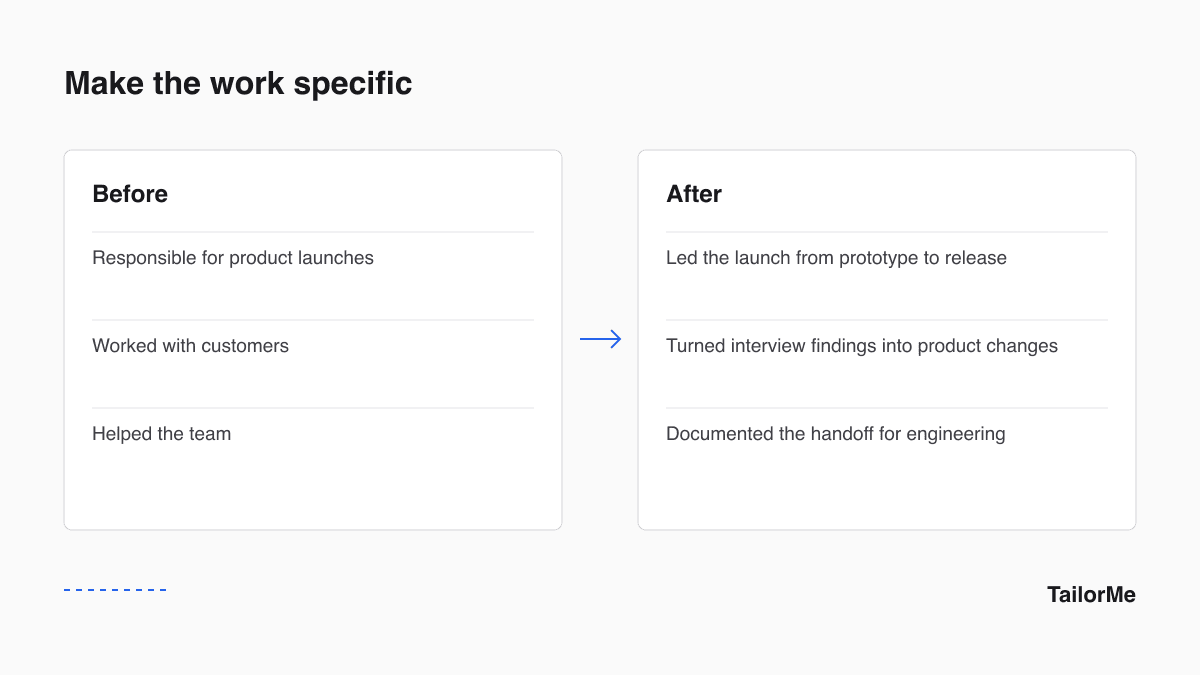
Most resumes do not fail because the person behind them is unqualified. They fail because the resume is trying to speak to three very different readers at the same time:
- The Applicant Tracking System that parses and ranks it
- The recruiter who skims it in seconds
- The hiring manager who wants proof you can do the job
That is a hard job for one document.
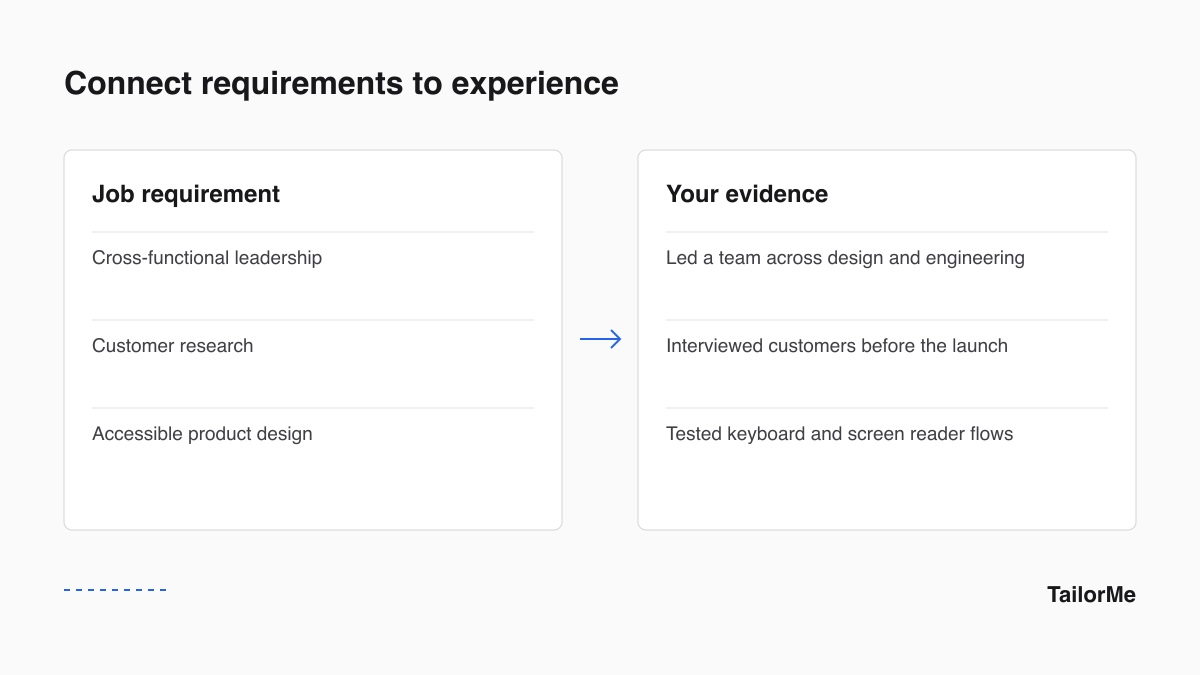
A strong resume needs clean formatting, relevant keywords, specific evidence, and a clear story about why your background fits this role. A great resume does one more thing: it changes for every job you apply to.
This guide walks through how to write a resume from top to bottom, what each section should do, and how to turn one strong Master Resume into tailored applications with TailorMe.
Start With the Job, Not the Resume
Most people open their resume first and ask, "How can I make this sound better?"
Start with a better question: "What does this job need to see?"
Before you rewrite anything, read the job posting and mark the language that matters:
- Job title and level
- Required tools, systems, and methods
- Repeated responsibilities
- Industry terms or role-specific phrases
- Outcomes the team cares about
- Preferred qualifications that match your background
This step matters because modern hiring is matching-heavy. ATS software and recruiter searches often look for the same terms used in the job description. If the posting says "customer lifecycle marketing" and your resume says "email campaigns," you may be describing related work, but the match is weaker than it should be.
Tailoring does not mean stuffing keywords into every sentence. It means translating your real experience into the employer's language.
Use a Format the ATS Can Read
Before a person reviews your resume, software may parse it into fields like name, job title, company, dates, education, and skills. If your layout is hard to parse, your strongest experience can disappear.
Use a simple structure:
- One column
- Standard section headers
- Clear company names, job titles, and dates
- Consistent spacing
- Plain bullets
- PDF export unless the employer asks for another file type
Avoid tables, text boxes, graphics, icons, progress bars, photos, and heavy design elements. They can look polished to you but messy to an ATS.
A resume is not a poster. It is a structured argument. The design should make the argument easier to read.
Build the Right Resume Sections
For most candidates, the strongest order is:
- Header
- Summary
- Work experience
- Skills
- Education
- Projects, certifications, or additional sections when relevant
Reverse chronological order works best for most people because recruiters expect it and it shows your recent impact quickly. A functional resume that hides dates or pushes work history down the page can raise questions, even when the intent is innocent.
There are exceptions. A student may lead with education and projects. A career changer may need a tighter summary and a projects section that bridges into the new role. But even then, clarity beats cleverness.
Write a Clean Header
Your header should make it easy to identify and contact you.
Include:
- Full name
- City and state, or city and country
- Professional email address
- Phone number
- LinkedIn profile
- Portfolio or GitHub link if relevant
Leave out personal details that do not help the hiring decision, such as full street address, birthday, marital status, headshot, or unrelated social profiles.
The header is not where you win the interview. It is where you avoid creating friction.
Write a Summary That Points at the Job
A resume summary is a short positioning statement. It should help the reader understand what kind of candidate you are and why your background fits the role.
Keep it to two or three focused sentences. Mention your role, relevant experience, strongest skills, and one or two proof points.
Weak summary:
"Motivated professional with strong communication skills and a passion for solving problems. Looking for an opportunity to grow and contribute to a great team."
Stronger summary:
"Product marketer with 5 years of experience launching B2B SaaS features, building sales enablement, and improving lifecycle campaigns. Led messaging and go-to-market work for products used by 40,000+ customers, with a focus on customer research, positioning, and revenue-facing content."
The second version is stronger because it gives the reader anchors: function, market, skills, scope, and outcomes.
If you are early in your career or changing fields, you can use the summary to connect your transferable experience to the target role. Just keep the focus on what you bring to the employer, not what you hope the employer gives you.
Turn Work Experience Into Evidence
Your work experience section is the core of the resume. It should not read like a job description copied from HR. It should show what you did, how you did it, and why it mattered.
A useful bullet has three ingredients:
- Action
- Context
- Result
Here is the difference.
Before:
After:
"Redesigned customer onboarding for mid-market accounts, reducing time to first value from 21 days to 12 days and improving activation by 18%."
The "after" version tells a much clearer story. It shows ownership, audience, metric, and business impact.
Use numbers whenever you can:
- Revenue influenced
- Customers supported
- Time saved
- Cost reduced
- Error rate improved
- Team size led
- Volume handled
- Conversion rate improved
- SLA or response time changed
If you do not have exact metrics, use scope and purpose:
| Instead of writing | Try writing |
|---|---|
| "Helped with reporting" | "Built weekly revenue dashboards used by sales leadership to track pipeline health" |
| "Worked on the website" | "Updated conversion pages for paid acquisition campaigns across 6 product lines" |
| "Managed projects" | "Coordinated launch milestones across design, engineering, legal, and support teams" |
| "Handled customer questions" | "Resolved technical onboarding questions for enterprise customers during implementation" |
Specificity is proof. The more concrete your bullets are, the easier it is for a recruiter to imagine you doing the work again.
Match the Experience to the Role
The same person can need different resumes for different jobs.
Imagine you are a software engineer applying to two roles:
- Role A emphasizes backend systems, distributed architecture, and reliability.
- Role B emphasizes customer-facing product work, experimentation, and frontend collaboration.
Your experience might support both. But the same bullets should not lead both resumes.
For Role A, lead with backend scale, system design, observability, and incident response. For Role B, lead with user-facing features, experiments, cross-functional work, and product outcomes.
Tailoring is not making things up. It is choosing the most relevant true details and putting them where the reader will notice.
Write a Skills Section That Helps Search and Skimming
The skills section gives ATS software and recruiters a fast way to verify fit.
Keep it practical:
- Use exact terms from the job posting when they truthfully apply
- Group related skills when the list is long
- Prioritize hard skills, tools, methods, and domain expertise
- Avoid vague soft skills unless the posting uses specific phrasing that you can support elsewhere
For example:
"Skills: SQL, Python, dbt, Snowflake, Looker, data modeling, experimentation, cohort analysis, lifecycle analytics"
That is stronger than:
Soft skills matter, but they are more convincing when shown through work experience bullets.
Keep Education Simple
For most candidates, education should be concise:
- Degree
- Field of study
- School
- Graduation year if helpful
- Honors, coursework, or activities only when relevant
If you have years of work experience, education usually belongs below experience. If you are a student, recent graduate, or changing fields through a degree or bootcamp, it can move higher.
Do not let education take over the page unless it is one of the main reasons you are qualified for the role.
Add Projects and Certifications When They Prove Fit
Additional sections are powerful when they answer a question the job posting is already asking.
Use a projects section when:
- You are early career and need more proof
- You are changing fields
- You have side projects that match the role better than your day job
- The job asks for a portfolio, technical work, writing samples, or shipped products
Use a certifications section when:
- The credential is required
- The credential is strongly preferred
- The certification proves a skill that is hard to show elsewhere
Keep these sections focused. A cloud certification matters for a cloud engineering role. A decade-old unrelated certificate probably does not.
Cut What Does Not Serve This Application
One of the hardest parts of resume writing is deleting good information.
But a resume is not a complete biography. It is a targeted document for one opportunity.
Cut or shrink anything that does not support the target role:
- Old roles with low relevance
- Repetitive bullets
- Tools the job does not care about
- Responsibilities that do not show impact
- Coursework or activities that no longer strengthen your case
- Generic phrases that could apply to anyone
This is where a Master Resume helps. You do not have to delete information forever. You keep the full version as your source of truth, then create a focused version for each job.
Proofread for Trust
Small mistakes can make a strong resume feel rushed.
Before you submit, check:
- Dates are consistent
- Tenses match current and past roles
- Company and product names are spelled correctly
- Bullets start with strong verbs
- Formatting is consistent
- Contact links work
- The resume matches the job title and company
- The PDF exports cleanly
Also read it out loud. Awkward bullets reveal themselves quickly when spoken.
How TailorMe Makes Resume Writing Faster
You can do all of this manually. For one application, that is reasonable.
But a real job search can involve dozens of applications. Reading every posting, finding keywords, selecting the right achievements, rewriting bullets, checking formatting, and exporting a new PDF can take 30 to 45 minutes per job.
That is why TailorMe is built around a different workflow:
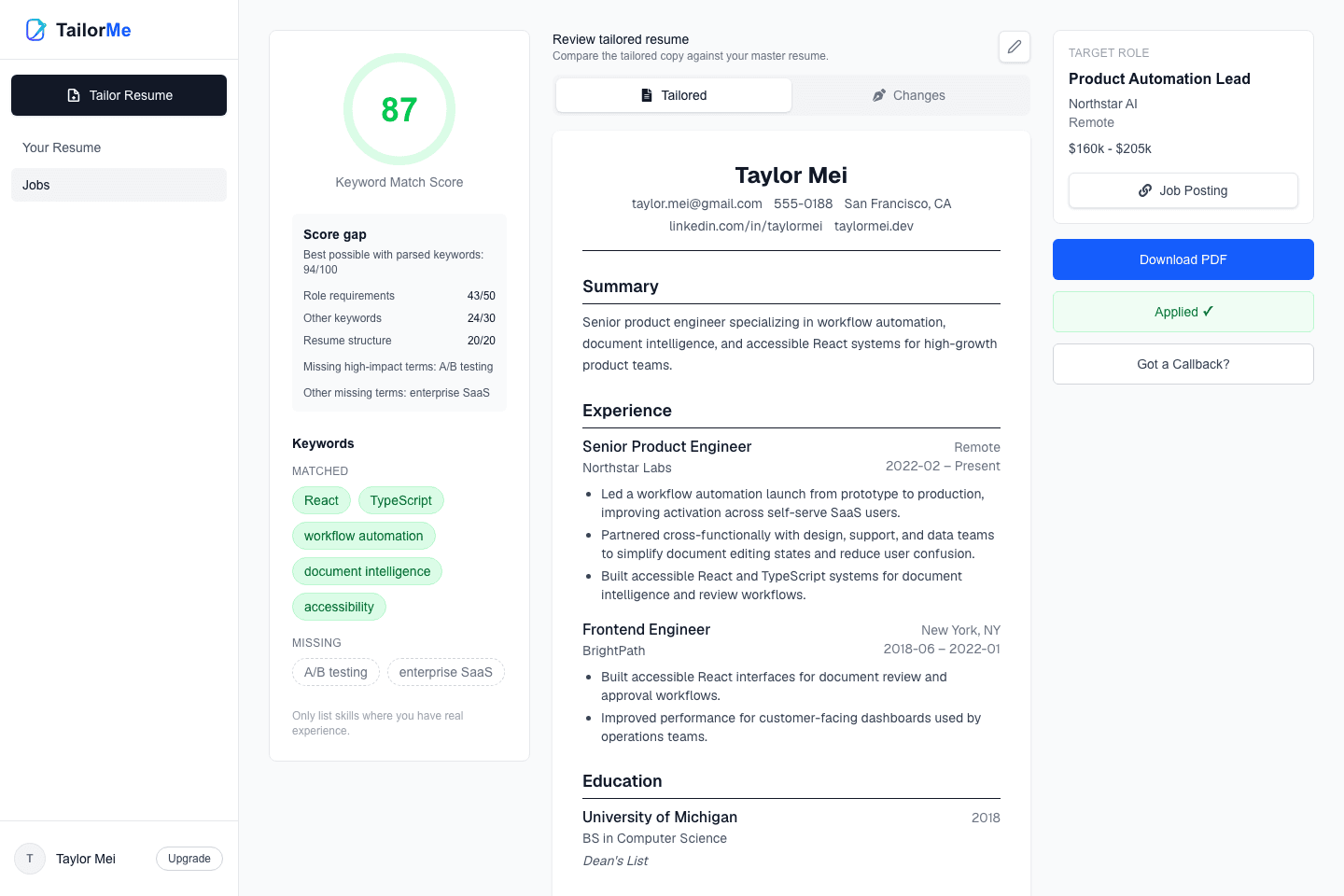
- Create your Master Resume. Add your full career history, including roles, projects, skills, education, certifications, and detailed accomplishments.
- Add a job posting. Paste the description or job URL so TailorMe can identify the role's requirements and terminology.
- Generate a tailored resume. TailorMe selects the most relevant experience, mirrors the job posting's language where truthful, and keeps the output ATS-friendly.
- Review and download. You stay in control of the final resume before you apply.
The point is not to make your resume sound like everyone else's. It is to make your real experience easier for hiring systems and hiring teams to understand.
Resume Writing Checklist
Before you send your next application, run through this list:
- Is the layout clean and ATS-friendly?
- Does the summary point toward this specific role?
- Do the first few bullets match the employer's most important requirements?
- Are achievements specific and evidence-based?
- Does the resume use the job posting's language where accurate?
- Are skills listed in the terms recruiters are likely to search?
- Is the final version focused, not overloaded?
- Did you proofread names, dates, links, and formatting?
If the answer is yes, you are no longer sending a generic resume. You are sending a clear, targeted case for why you fit the role.
That is what a resume is supposed to do: earn the next conversation.
Ready to tailor your next application?
Upload your Master Resume, add a job posting, and get a resume built for that role in minutes.
Start tailoring for free