How to Tailor a Resume to a Job Description (Step by Step)
A practical method for turning a job description into a focused, truthful resume—with a requirement-to-proof table, examples, and a final checklist.
Tailor your resume before you apply.
Upload your Master Resume, paste a job posting, and review a role-specific resume in minutes.
Start tailoring for free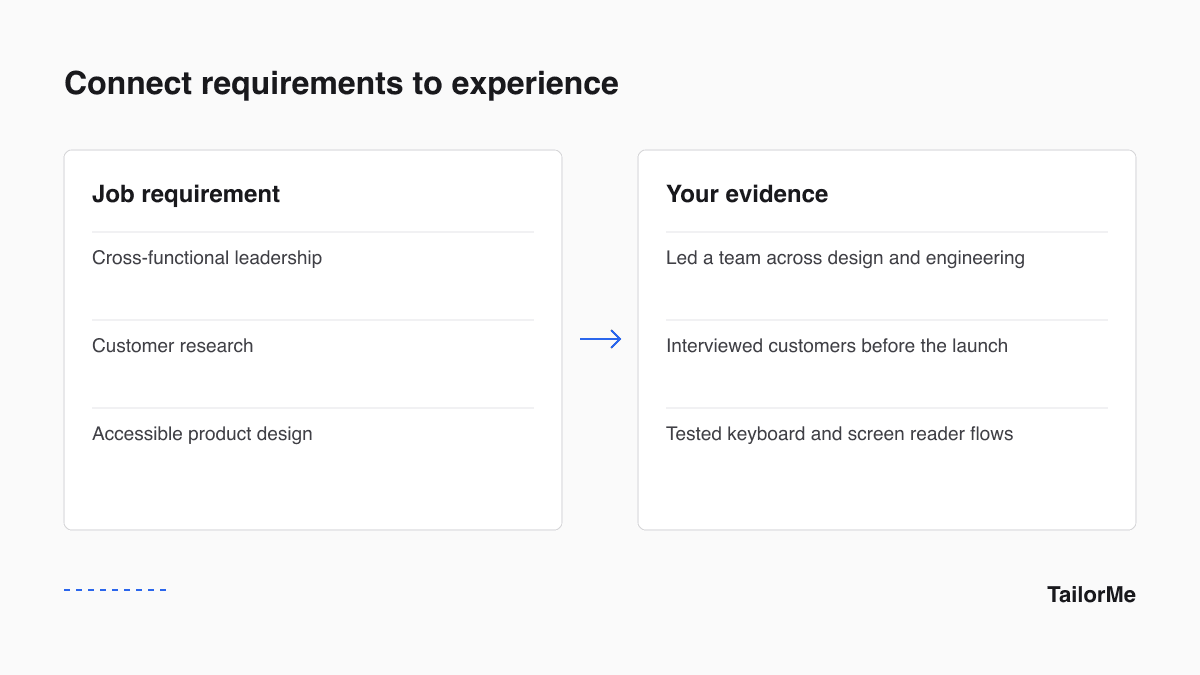
To tailor a resume to a job description, identify what the employer needs, match each important requirement to evidence from your actual experience, and make the strongest matches easy to find. Use the employer’s language when it is accurate, but never add a skill, result, or responsibility you cannot defend in an interview.
The goal is not to rewrite your career for every application. It is to select the most relevant parts of your career and explain them in the clearest language for one role.
This guide gives you a repeatable process, including a requirement-to-proof table, a worked example, and a checklist you can use before you apply.
What does it mean to tailor a resume?
A tailored resume is a role-specific version of your resume. It emphasizes the skills, outcomes, and experience most relevant to one job posting while keeping every claim factually accurate.
Tailoring can involve:
- Reordering bullets so the most relevant evidence appears first
- Replacing a general phrase with the employer’s more specific term when both mean the same thing
- Adding a relevant project or accomplishment that was stored in your Master Resume
- Removing details that use space without helping the employer evaluate your fit
- Rewriting your summary and skills section around the role’s real priorities
It does not mean copying the job description, hiding a missing qualification, changing your job title, or inventing a metric.
That distinction matters. A keyword may help a recruiter or applicant tracking system find your resume, but the evidence attached to that keyword is what makes it credible.
Step 1: Decide whether the role is worth tailoring for
Before editing your resume, read the entire job description once without highlighting anything. Your first question is not “Which keywords should I add?” It is “Is this role a reasonable match for my experience and goals?”
Look for the few requirements that define the job:
- The main outcome the person is expected to own
- The core technical, operational, or domain skills
- The expected level of scope or seniority
- Any license, clearance, location, or work-authorization requirement
- The difference between required and preferred qualifications
Do not reject yourself because you miss one preferred item. Job descriptions often describe an ideal candidate, not the only candidate an employer would consider. But treat a genuine non-negotiable honestly. Tailoring can clarify relevant experience; it cannot create a license or five years of experience you do not have.
If the role is a poor match, skipping it may create more value than polishing an application that is unlikely to move forward.
Step 2: Turn the job description into a priority list
Read the posting again and mark phrases in four groups:
| Group | What to capture | Examples |
|---|---|---|
| Outcomes | What the hire should improve, deliver, or own | Reduce churn, launch a platform, grow enterprise accounts |
| Hard skills | Tools, methods, systems, and domain knowledge | SQL, Salesforce, financial modeling, Kubernetes |
| Scope | Team size, budget, geography, complexity, or seniority | Lead five engineers, own a $2M budget, support global operations |
| Working style | How the person is expected to operate | Cross-functional leadership, customer communication, ambiguity |
Repeated phrases can signal importance, but repetition is not the only clue. The first few responsibilities, the required qualifications, and language about what success looks like usually deserve more attention than a long list of generic traits.
Oregon State University’s Writing Center recommends identifying required and preferred qualifications, highlighting the job description’s verbs, and looking for repeated words. It also recommends creating a table that pairs the employer’s keywords with your corresponding skills. That is a stronger starting point than dropping a list of keywords into a resume without context. See its one-page resume tailoring guide.
Step 3: Build a requirement-to-proof table
Now map the employer’s priorities to evidence from your career. Use your full work history, projects, volunteer work, education, and other relevant experience—not just the shortened resume you submitted last time.
Here is the basic structure:
| Job requirement | Evidence from your experience | Strength | Resume action |
|---|---|---|---|
| Lead cross-functional launches | Coordinated product, design, sales, and support for a billing launch | Strong | Move launch bullet to the top |
| Use data to improve adoption | Built an activation dashboard and used it to prioritize onboarding fixes | Strong | Add tool and measured result |
| Enterprise customer research | Joined six customer calls but did not own the research program | Partial | Describe contribution accurately |
| Healthcare experience | No healthcare work or projects | Missing | Do not claim it; leave off |
This table prevents two common mistakes.
First, it stops keyword-first editing. You are required to find proof before adding language. Second, it exposes relevant experience that may be missing from your current resume but present in your broader career record.
Use a simple strength label:
- Strong: You have direct, recent evidence and can explain the result.
- Partial: You contributed, used a related skill, or worked at a smaller scope.
- Missing: You do not have defensible evidence.
Strong matches belong near the top of the resume. Partial matches need precise wording. Missing items do not belong on the resume at all.
Step 4: Choose the story your resume needs to tell
A job description is not just a bag of keywords. It describes a problem the employer wants someone to solve.
After building your table, finish this sentence:
This employer needs a [type of person] who can [main outcome] using [two or three critical capabilities].
For example:
This employer needs a product operations manager who can improve launch execution using cross-functional planning, analytics, and process design.
Your tailored resume should make that story visible within the first half of the first page. That does not require a clever design. It requires a focused summary, relevant skills, and strong evidence in the first bullets a reader sees.
If your resume is still trying to present you equally as a marketer, project manager, analyst, and customer-success leader, the employer has to decide which version of you matters. Tailoring makes that decision easier.
Step 5: Tailor each resume section in the right order
Start with the sections that carry the most evidence. Do not spend ten minutes adjusting the summary while leaving generic experience bullets untouched.
Work experience
For each relevant role:
- Move the most relevant accomplishment to the first bullet.
- Name the skill or responsibility using the employer’s wording when it is accurate.
- Add context: what you built, improved, managed, or changed.
- Add a verified result, scale, or constraint when one exists.
- Cut or shorten bullets that compete with stronger evidence.
Suppose a posting emphasizes “cross-functional launch planning” and “improving customer onboarding.” Your original bullet says:
If your actual experience supports it, a tailored version could say:
Led cross-functional launch planning across product, design, and support for a new onboarding flow, reducing time to first completed project from five days to three.
The improved version does more than add keywords. It explains your ownership, collaborators, work, and result. Only use the metric if you can verify it.
For a deeper bullet-writing method, see How to Write a Resume That Gets Interviews.
Summary
Write the summary after tailoring your experience. That way, it reflects the evidence already on the page.
A useful summary usually includes:
- The professional identity that fits the role
- The most relevant area of experience
- Two or three capabilities the employer prioritizes
- One differentiating outcome or area of scope
Avoid strings of unsupported adjectives such as “dynamic, visionary, results-driven leader.” A summary should orient the reader, not ask them to accept a collection of claims on faith.
Skills
Use the exact term from the posting when it truthfully describes your skill. If the posting says “Google Analytics 4” and you have used GA4, write “Google Analytics 4 (GA4)” rather than only “web analytics.”
Do not add every phrase from the posting. Prioritize hard skills, tools, methods, certifications, and domain knowledge that a recruiter might reasonably search for. Soft skills are usually more convincing when demonstrated in an experience bullet.
Projects, education, and optional sections
A project can be useful when it supplies evidence your work history does not show clearly, especially for students, career changers, and people returning to work. Certifications and coursework can support a qualification, but they should not be presented as equivalent to professional experience when they are not.
Keep education simple unless the posting makes a degree, field of study, academic project, or credential important.
Step 6: Use resume keywords without keyword stuffing
Resume keywords work best when they are attached to proof.
Indeed’s current resume-tailoring guide recommends using the job description’s language in the summary, work history, and skills section, with the most relevant responsibilities first. The important part is integration: the same term can help both a search tool and a human reader understand your fit.
Use these rules:
- Prefer exact hard-skill terms when they are true: “Power BI,” not only “reporting tools.”
- Include both a spelled-out term and its common acronym when useful: “search engine optimization (SEO).”
- Use a keyword in the section where it naturally belongs.
- Mention an important skill more than once only when each use adds new evidence.
- Keep wording readable. A sentence built for a recruiter should not sound like a search query.
Never hide keywords in white text, paste the whole job description into the document, or add a “skills” list full of tools you have never used. Those tactics make the resume less trustworthy and can create serious problems in an interview.
Our guide to how applicant tracking systems work explains why clean structure and relevant language matter without treating an ATS as a machine you can trick.
Step 7: Handle missing qualifications honestly
When your table shows a gap, choose one of four actions:
- Leave it out. If you have no evidence, do not include the claim.
- Show adjacent experience. Describe the related work and let the employer judge the transfer.
- Add real evidence. A completed course, project, portfolio sample, or certification may demonstrate a new skill.
- Skip the role. Some gaps are central enough that your time is better spent elsewhere.
Be especially careful with years of experience, people management, regulated work, security clearances, professional licenses, and named software. Changing “supported a team lead” to “led a team” is not tailoring. It is a different claim.
When AI helps with your resume, ask it to identify gaps and request clarification instead of filling those gaps itself. Every generated line should be traceable to information you supplied and understandable in your own words.
Step 8: Run a human and ATS-friendly final check
Read the finished resume twice: once like a recruiter and once like a skeptical interviewer.
On the recruiter pass, ask:
- Is the target role obvious?
- Are the strongest matches visible near the top?
- Do the first bullets show relevant outcomes, not just duties?
- Can I find the most important tools and skills quickly?
- Is the document concise and easy to scan?
On the interviewer pass, ask:
- Can I explain every bullet without improvising?
- Are all numbers, dates, titles, and tools accurate?
- Did I overstate ownership or seniority?
- Did an AI rewrite change the meaning of my work?
Finally, use a simple document structure with standard section headings and confirm that the employer accepts your file type. Check spelling, links, dates, and the filename. Our resume issues checklist covers the most common problems that can still weaken a well-tailored application.
A 15-minute resume tailoring checklist
When the role is already close to your background, use this focused pass:
Minutes 1–3: Identify the priorities
- Mark the main outcome, required qualifications, hard skills, and scope.
- Separate required items from preferred ones.
- Decide whether the role is worth the application.
Minutes 4–7: Match requirements to proof
- Find evidence in your Master Resume or career record.
- Label each important match strong, partial, or missing.
- Choose the three to five points the employer should see first.
Minutes 8–12: Edit for relevance
- Reorder the strongest experience bullets.
- Rewrite vague bullets with accurate context and results.
- Update the summary and skills section.
- Remove details that distract from the role.
Minutes 13–15: Verify
- Compare the resume with the posting one last time.
- Check every claim, number, keyword, and title.
- Proofread the PDF or document the employer will actually receive.
Some applications deserve more than 15 minutes. Career pivots, major increases in seniority, unusual hybrid roles, and dream jobs usually need a slower review. The checklist is a practical routine, not a reason to rush high-stakes work.
How much of a resume should change for each job?
Usually, less than you think. Your employers, dates, education, and core accomplishments should remain stable. The parts that most often change are the summary, skills order, bullet order, wording, and which projects or accomplishments receive space.
If every application requires a complete rewrite, your source resume may be too thin. Build a more complete Master Resume first, then select from it rather than trying to remember your whole career under deadline pressure.
Should you tailor your resume for every application?
Tailor for every role you seriously want, but match the effort to the opportunity. A close-fit role may need a short relevance pass. A career pivot may need a different story, more supporting projects, and feedback from someone in the field.
The useful standard is not “Did I change enough words?” It is “Can this employer quickly see the strongest truthful evidence that I can do this job?”
Can AI tailor a resume safely?
Yes, if AI works from a complete career record, distinguishes evidence from gaps, and keeps you in the review loop. It should help compare, select, reorder, and clarify. It should not invent missing qualifications or silently upgrade your level of ownership.
TailorMe is designed around that evidence-first workflow: upload a Master Resume, add a job posting, answer follow-up questions when relevant experience is missing from the source, and review the changes before exporting. Whether you tailor manually or use a tool, the final resume should still sound like you and remain fully defensible.
Ready to tailor your next application?
Upload your Master Resume, add a job posting, and get a resume built for that role in minutes.
Start tailoring for free