Build a Master Resume You Can Tailor for Each Role
Keep your experience in one place, then select the relevant details for each application.
Tailor your resume before you apply.
Upload your Master Resume, paste a job posting, and review a role-specific resume in minutes.
Start tailoring for free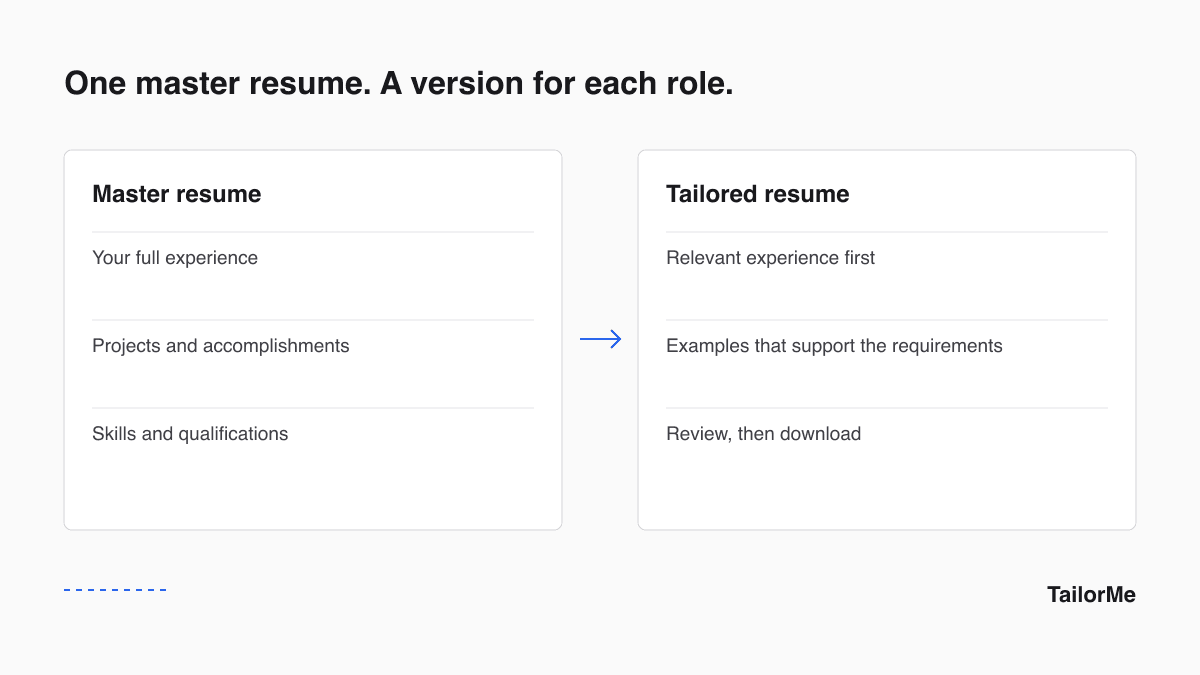
If you've ever agonized over which bullet points to keep and which to cut from your resume, you already know the problem: a one-page resume can never capture everything you bring to the table.
Most job seekers maintain a single resume. They tweak a word here, swap a bullet point there, and hope for the best. But every time they leave something out, they risk hiding the exact experience a hiring manager is looking for.
There's a better way.
What is a Master Resume?
A Master Resume is a comprehensive, living document that contains every role, project, skill, certification, and accomplishment from your career. It isn't something you send to employers. It's the raw material from which perfect, targeted resumes are built.
Think of it like a warehouse. You wouldn't ship the entire warehouse to a customer. But having everything organized and available means you can always assemble exactly the right shipment, fast.
A typical Master Resume might be three, five, or even ten pages long. And that's perfectly fine, because no one will ever see it but you.
The important difference is purpose. A submitted resume is a sales document. It should be focused, concise, and shaped for one role. A Master Resume is a source document. It should be complete, searchable, and honest. You are not trying to impress anyone with it. You are trying to capture enough raw material that every future application can be specific.
Why most resumes fall short
When you maintain a single resume, you're forced to make painful trade-offs:
- You leave out relevant experience. That side project where you built a data pipeline? It didn't make the cut for your last application, but it's exactly what this new role needs.
- You use generic language. Instead of mirroring the terminology in a specific job posting, you default to broad descriptions that don't catch a recruiter's eye (or an ATS keyword scan).
- You over-index on your most recent role. Your current job dominates the page, even when an older role is more relevant to the position you're applying for.
The result: you send the same resume to dozens of companies and wonder why you're not hearing back.
The problem gets worse as your career gets more varied. A generalist operator might have experience in customer support, analytics, process design, hiring, and vendor management. A software engineer might have backend, frontend, infrastructure, mentoring, and product work. A marketer might have lifecycle campaigns, launches, positioning, content, and revenue reporting. One standard resume cannot lead with all of those at once.
That is why many strong candidates accidentally look average. Their resume contains good work, but the most relevant proof is hidden because the document is trying to serve every possible job.
How TailorMe puts your Master Resume to work
This is exactly the problem TailorMe was built to solve. Here's how it works:
- Upload your Master Resume once. Include everything: every role, every project, every skill. The longer and more detailed, the better.
- Paste a job posting. Drop in the URL or the full job description. TailorMe's AI extracts the key requirements, preferred qualifications, and the language the company uses.
- Get a perfectly tailored resume. TailorMe selects the most relevant items from your Master Resume, reorders and emphasizes them, and mirrors the job posting's terminology, all while keeping your resume concise and ATS-friendly.
The result is a resume that reads like you wrote it specifically for that role, because you did. You just had AI do the heavy lifting.
Tips for building your Master Resume
Ready to get started? Here's how to build a Master Resume that gives TailorMe the best material to work with:
Include everything
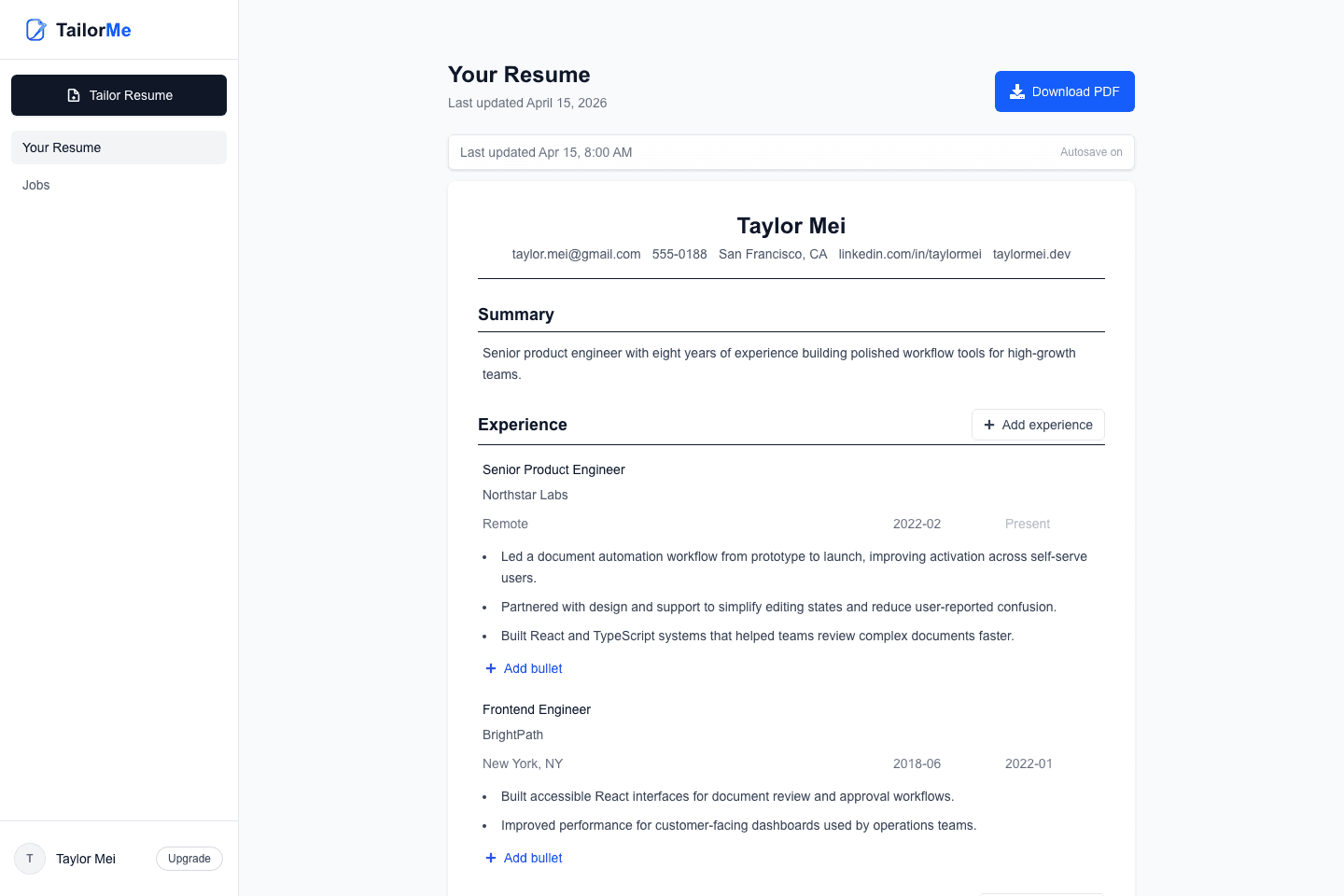
Don't self-edit. Add every position you've held, every project you've contributed to, every certification you've earned. Include volunteer work, freelance gigs, and side projects. You never know which experience will be the perfect match for a future role.
Include work that feels too detailed for a normal resume. Internal tools, process improvements, dashboards, customer migrations, training documents, incident response, vendor evaluations, launch planning, and cross-functional coordination can all become valuable when a job posting asks for that exact kind of proof.
For each role or project, capture:
- The business or team problem
- The audience or stakeholders
- The tools, systems, and methods used
- The scope, such as users, revenue, records, tickets, or transactions
- The outcome, even if it is directional rather than perfectly measured
- The words other teams used to describe the work
Those details make tailoring stronger because they give the system more than a job title to work with.
Use specific, quantified achievements
Instead of "Managed a team," write "Managed a team of 8 engineers, delivering a payment processing system that handled 2M+ transactions/month." Numbers give TailorMe concrete details to highlight when they match a job's requirements.
If you do not have exact numbers, use useful context. "Supported enterprise customers during onboarding" is weaker than "Supported enterprise customers during onboarding for security, data migration, and admin setup questions." The second version still avoids fake metrics, but it gives a future tailored resume more material.
Organize by category
Group your experience into clear sections: work experience, projects, skills, education, certifications, publications, volunteer work. This structure helps TailorMe understand the type of each entry and place it correctly in the tailored output.
Do not make the Master Resume elegant at the expense of clarity. Use plain section names. Keep projects attached to the role where they happened when possible. If a project spans multiple roles, describe the timeline and your ownership clearly so it does not look like duplicate experience.
Keep it updated
Every time you finish a project, earn a certification, or learn a new tool, add it to your Master Resume. The more current and complete it is, the better your tailored resumes will be.
The easiest habit is a monthly 10-minute update. Add new projects while you still remember the context. Write down metrics before dashboards change. Save language from performance reviews, launch notes, customer feedback, or project retrospectives. Those phrases often become the strongest proof later because they describe impact in concrete terms.
What Not to Put in a Submitted Resume
A Master Resume can be long, but the resume you send should still be selective. Do not submit every project just because it is true. Leave out details that distract from the target role, older work that does not add signal, and tools that make you look unfocused for the job in front of you.
For example, if you are applying for a product operations role, your tailored resume might emphasize process design, stakeholder management, data quality, enablement, and launch coordination. If you are applying for a data analyst role, the same Master Resume might emphasize SQL, dashboards, experimentation, data modeling, and business recommendations.
The source material can be the same. The submitted story should be different.
Keep a Version History
Save the tailored resume you send for each role. When an interview comes in two weeks later, you need to know which bullets, keywords, and projects the employer saw. This is especially important if you tailor aggressively for different roles.
A simple version history also helps you learn. If one version gets callbacks and another does not, compare the job posting, the resume focus, and the proof you chose to lead with. Over time, those patterns make your Master Resume and your tailoring decisions sharper.
Your Master Resume gets better with every application
Here's something most people don't expect: applying to more jobs actually makes your Master Resume stronger.
Every time you tailor a resume for a new role, TailorMe reviews your existing Master Resume against that job posting and asks you targeted follow-up questions. Things like: "This role requires experience with distributed systems — have you worked on anything like that?" or "They're looking for someone who's managed vendor relationships. Does any of your past work cover that?"
These questions surface experience you may have forgotten to include, or didn't think was relevant enough to add. A consulting project from three years ago. A process you built that never made it onto your resume. A skill you picked up on the side.
Your answers get folded back into your Master Resume automatically. So the next time you apply, TailorMe has even more to work with.
Over time, your Master Resume becomes a genuinely complete picture of your career. And the more complete it is, the more precisely TailorMe can match you to the roles you actually want. Every application compounds. The tenth job you apply to gets a better tailored resume than the first, because your Master Resume has grown with you.
That's the flywheel: apply to jobs, fill in gaps, build a richer Master Resume, get better matches, land more interviews.
Stop applying with a generic resume
The job market rewards specificity. Companies want to see that you have the exact skills they're hiring for, described in the language they use.
A Master Resume gives you the raw material. TailorMe gives you the tailoring engine. Together, they let you apply to every job with a resume that's built for it, without spending hours rewriting from scratch.
Ready to tailor your next application?
Upload your Master Resume, add a job posting, and get a resume built for that role in minutes.
Start tailoring for free